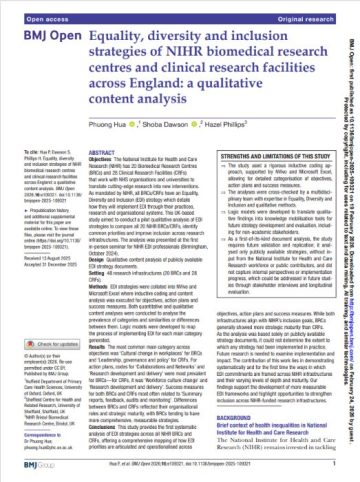
Analysis of the equality, diversity and inclusion strategies at NIHR Biomedical Research Centres and Clinical Research Facilities
A new study provides the first systematic analysis of equality, diversity and inclusion (EDI) strategies across all NIHR Biomedical Research Centres (BRCs) and NIHR Clinical Research Facilities (CRFs). It maps how EDI priorities are expressed in the organisations’ objectives, action plans and success measures.
The study was funded by Bristol BRC and performed by staff at the University of Bristol Centre for Academic Primary Care, Sheffield BRC and Bristol BRC. It is published in BMJ Open.
BRCs and CRFs are funded by NIHR to work across universities and NHS trusts to turn cutting-edge research into new treatments, diagnostics and health technologies.
All BRCs and CRFs have an EDI strategy which details how they will implement EDI in their systems, practices and research. The purpose of the strategies is to find ways to promote inclusion among staff, research participants and public contributors, and help reduce health inequalities in the UK.
The organisations’ individual strategies stem from the wider NIHR Research Inclusion Strategy 2022-2027.
The review looked at the EDI strategies across all 20 NIHR BRCs and all 28 NIHR CRFs. It found that the most common category within the EDI strategies’ objectives was:
- ‘Cultural change in workplaces’ for BRCs
- ‘Leadership, governance and policy’ for CRFs
In the strategies’ action plans, the most common categories were:
- ‘Collaborations and networks’ and ‘Research development and delivery’ for BRCs
- ‘Workforce culture change’ and ‘Research development and delivery’ for CRFs
The most common category in the strategies’ success measures was ‘Summary reports, feedback, audits and monitoring’ for both BRCs and CRFs.
Overall, the study found that BRCs’ and CRFs’ EDI strategies align with NIHR’s inclusion goals, but their depth, maturity and measurability varies. In general, BRCs tend to have more comprehensive, measurable strategies than CRFs.
The research paper also provides logic models which can be used to work out how to monitor progress and measure success of EDI objectives.
The researchers hope this study will pave the way for future research to find out how EDI strategies within NIHR infrastructure are implemented, and the impact they have.
Dr Phuong Hua, study lead, said:
“It is significant that for the first time, we’ve mapped the equality, diversity and inclusion strategies across every NIHR BRC and CRF in England. This gave us a benchmark for how inclusion is being planned and evaluated.
“We found that most centres share the same aims, like building inclusive workplaces and improving accessibility in research. At the same time, they differ greatly in how clearly they outline action plans and measure success. The logic models provide a practical tool that teams can adapt locally to improve consistency.
“The next step for the sector is stronger evaluation of what is implemented, what works, and what impact this has.”