
The benefits of using NIHR’s Be Part of Research service
In this blog Jody Salton, PhD candidate from our diet and physical activity (DPA) research theme, discusses using the National Institute for Health and Care Research’s (NIHR) Be Part of Research service to recruit participants for her study and provides a step-by-step breakdown of what she did to achieve this.
At the beginning of 2026, I used Be Part of Research to recruit participants for a study on dietary iron selection. I wanted to recruit people who were experiencing heavy menstrual bleeding to explore the dietary choices they made across the menstrual cycle.
Dietary iron selection involves choosing between foods containing iron that is easily absorbed (from animal sources) and foods containing iron that is less easily absorbed (plant-based and fortified sources) to meet daily requirements.
My study involved online food choice tasks and at-home finger-prick iron status testing kits. I asked participants to complete these at multiple points across the menstrual cycle.
The Be Part of Research service not only allowed me to recruit a usually hard-to-find sample, but it also helped my data reflect the experiences of participants across the whole of the UK.
I have detailed information about my experience below. If you have any questions about using Be Part of Research from a researcher’s perspective, please feel free to reach out.
What is Be Part of Research?
Be Part of Research is an initiative funded by the Department of Health and Social Care (DHSC) and run by the NIHR. Its goal is to connect researchers and participants.
From a researcher’s perspective, using Be Part of Research speeds up the recruitment process. It also allows the public to engage with studies they may not otherwise have been aware of.
The service is free to use, and, as of April 2026, there are 708,000 people signed up to the registry as potential study participants.
Sign-up is open to anyone in the UK over the age of 18. When signing up, a person can select up to 10 conditions and/or areas of health research they are interested in. This includes the option of signing up as a ‘healthy volunteer’.
Example areas include:
- Healthy volunteer – 98,288 people currently enrolled
- Mental health and wellbeing – 48,824 people currently enrolled
- Type 1 diabetes – 10,764 people currently enrolled
- Type 2 diabetes – 36,605 people currently enrolled
- Prostate cancer – 16,506 people currently enrolled
- Breast cancer (both male and female) – 27,667 people currently enrolled
There is also the option of whether the study should be in person or remote.
There are currently 15,000 people signed up in Bristol. Almost 2,600 are signed up as healthy volunteers.
A step-by-step breakdown of using the service
If you decide to use Be Part of Research, someone from the service will be there to guide you through the steps you need to complete from start to finish.
Read on for my step-by-step breakdown of what my research journey with Be Part of Research looked like:
Step 1: Getting your study ethically approved and listed on a research registry
I used the ISRCTN registry. It’s free to use for studies using an interventional design and has a fee for observational designs. An example of my registration is linked here.
Step 2: Produce a lay summary of the study to send out in emails to participants
Be Part of Research sends you a template showing you what needs to be included – you fill in the gaps for what the study is about, who is eligible, and how to get involved (e.g., a link to the information sheet/sign-up page).
Step 3: Decide how you will report back to the service on how many people signed up from Be Part of Research
This can either be non-identifiable (asking where the participant heard about the study) or identifiable (asking participants to provide a unique identifier when signing up).
Step 4: Submit an ethics amendment for the use of Be Part of Research
The service provides standardised text. You include this in your application. You should also attach the email that will be sent to participants. My amendment got approved within a fortnight without any comments.
Step 4: Decide who should be sent the mailouts
Someone from Be Part of Research will produce a search list that may apply to your study. This includes any restrictions on sex, age, and location, as well as relevant ‘areas of interest’. You can then provide feedback on whether there is anything that is missing, or whether any ‘areas of interest’ may be unsuitable.
Step 5: Plan your mailouts
There is no limit on the number of mailouts you can do.
I found it useful to conduct a slightly smaller initial mailout to estimate interest in my study. My initial mailout was 200 with a recruitment goal of 65 participants. From this, I determined that around 5% of people would register interest, 2% of which would be eligible to take part. However, this rate will be different for every study.
I did 7 mailouts, contacting a total of 5,750 volunteers. Out of this total, 370 registered interest and 110 continued as participants. However, my study had a very specific set of recruitment criteria. Therefore, it is likely that most studies will have a higher ratio of number contacted to number signed up.
Regarding the speed of sign-up following a mailout, most participants registered interest within a few hours. Below is an example timeline of a 2,500-person mailout sent at 9 am:
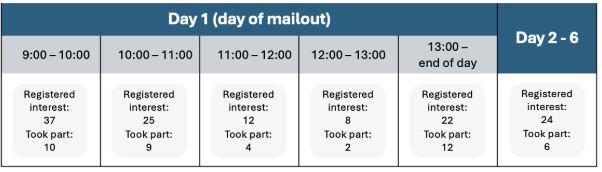
Step 6: Report recruitment numbers
You can do this incrementally during recruitment or as a bulk input at the end.
What makes a study eligible?
The key requirement is that the study should be on the NIHR Research Delivery Network (RDN) portfolio and/or in receipt of NIHR funding. Other than that, the research should fall under the umbrella of health and social care research and aim to recruit adults in the UK.
How to use the service
To register interest in using the service, you should complete the study registration formstudy registration form. To find out more about the service, you can head to the Be Part of Research website or contact the Be Part of Research team at bepartofresearch-volunteerservice@nihr.ac.uk.
Final thoughts
My experience of Be Part of Research has been undeniably positive. Whilst using the service does add a step to getting the study up and running, the people who signed up have been lovely and genuinely interested in the research being done.
From a practical perspective, the service is also an efficient approach to recruitment, particularly for studies using intervention designs and samples that are usually difficult to recruit. I would definitely recommend considering the service as a recruitment strategy.