Review update provides go-to resource for shared-decision making questionnaires
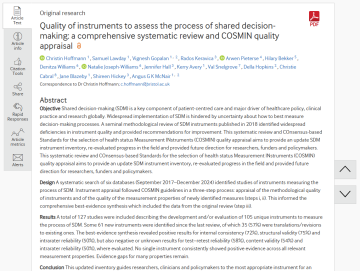
Researchers from the UK collaborated with colleagues from the Netherlands to create an up-to-date inventory of shared-decision making (SDM) instruments. Their work is a robust instrument quality assessment and re-evaluation of progress in the field, since a seminal review published in 2018.
Using COSMIN standards (a widely recognised framework for evaluating measurement instruments) researchers examined more than 100 instruments designed to capture the SDM process.
While some instruments demonstrated strengths in areas such as internal consistency and structural validity, these were not consistent across other domains.
The review team frequently found limited evidence for content validity (whether a tool accurately reflects real-world shared decision-making) and poorly evaluated test–retest reliability (whether results are stable over time).
Despite this, researchers saw growth in the field. They identified 61 new instruments, developed since the last review. Although some newer instruments were translations or revisions of existing tools, rather than fundamentally new approaches designed to address known gaps.
Implications for research and healthcare
Authors hope their updated inventory guides researchers, clinicians and policymakers to the most appropriate instrument for their context / population.
This is especially important given the increasing role of SDM in healthcare policy and service evaluation.
If SDM cannot be measured reliably, it becomes difficult to determine whether interventions are effective or whether patients are meaningfully involved in decisions about their care. Therefore, accessing appropriate measurement instruments is the first step towards evaluating performance and impact.
Refining, strengthening and validating existing instruments
The review calls for a shift towards refining and strengthening existing instruments. This includes conducting more comprehensive validation studies that assess all relevant measurement properties.
Greater standardisation and improved reporting, in line with COSMIN guidance, are also needed to support comparison across studies and build a more reliable evidence base.
Dr Christin Hoffmann, Research Fellow at the Bristol Medical School and corresponding author, said:
“While SDM is a healthcare policy priority in many countries, its measurement remains inconsistent.
“Improving the quality of SDM measurement will be essential to understanding how well SDM interventions work in practice.
“By prioritising robust psychometric evaluation, we can help ensure that SDM is accurately assessed and drive forward evidence for effective interventions.”