Antidepressant use in pregnancy linked to small increases in some birth risks, study finds
An international study led by researchers from the UK, Norway and Sweden has found that antidepressant use during pregnancy may be associated with a small increase in the risk of preterm birth and a low Apgar score, although the overall chance of these outcomes remained low.
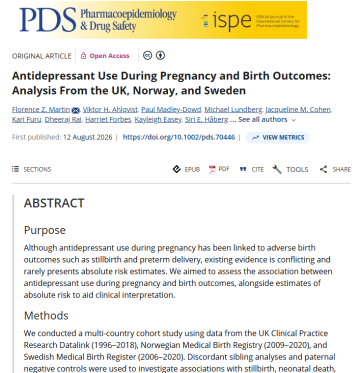
The research, published in Pharmacoepidemiology and Drug Safety, analysed health records from more than 2.5 million pregnancies. The study team, from the MRC Integrative Epidemiology Unit, the Karolinska Institutet and the Norwegian Institute of Public Health, found that around 120,000 of those (4.8%) involved antidepressant use.
Findings suggest that pregnancies exposed to antidepressants were slightly more likely to end in:
- Stillbirth
- Preterm delivery
- Low Apgar score at 5 minutes after birth
Doctors use the Apgar score to assess a baby’s condition shortly after birth. Scores range from 0 to 10, with scores of 7 to 10 generally considered reassuring. In this study, researchers looked at scores below 7 at 5 minutes after birth.
Despite the risk of stillbirth, preterm delivery and a low Apgar score being higher among pregnancies exposed to antidepressants, researchers found that the absolute increase in risk was small. The risk of stillbirth lessened when only looking among women with depression or anxiety.
Absolute risk describes the actual chance of something happening, rather than how much more likely it is in one group compared with another. For example, the predicted absolute risk of stillbirth was 0.34% among pregnancies not exposed to antidepressants and 0.40% among exposed pregnancies. This is equivalent to around 3 to 4 stillbirths per 1,000 pregnancies.
The team also compared sibling results and antidepressant use among fathers as a “negative control” to explore whether the associations might be explained by shared family, genetic or environmental factors. These analyses suggested that some of the increased risk, particularly for preterm birth and low Apgar score, may reflect other shared factors not accounted for in the analysis rather than the medication alone.
Lead author Florence Z. Martin said:
“Our findings are reassuring for those needing to use antidepressants during pregnancy but should be interpreted with care. We found small increases in some adverse birth outcomes among pregnancies where antidepressants were used, but the absolute risks remained low. These results aim to support evidence-based decision-making regarding antidepressant use during pregnancy.
“Depression and anxiety can vary over time, and the severity of a person’s mental health condition is difficult to measure fully in routine health records. This makes it challenging to separate the potential effect of medication from the effect of the underlying condition.”
The authors emphasise that the study cannot prove antidepressants directly cause the outcomes discussed in the paper. However, as medication use during pregnancy is often stigmatised despite a lack of evidence, it is important for pregnant people and clinicians to fully understand the potential risks of medication and the risks of untreated depression or anxiety before making treatment decisions.