Best practice resources needed to guide online activity discussions with young people
Mental health practitioners need best practice resources to support conversations around online activity with young people. Guidance should support conversations that are both acceptable to young people and effective at changing problematic online activity.
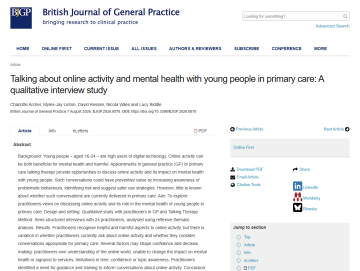
Researchers from the NIHR Biomedical Research Centre: Bristol and the University of Bristol conducted semi-structured interviews with 24 mental health practitioners working in primary care. The study team wanted to explore practitioner’s views on discussing online activity and its role in the mental health of young people in general practice (GP) and talking therapy services.
Interviewers found that not all practitioners are routinely discussing online activity with young people and not all of them consider these conversations to be appropriate in a primary care setting. Even when conversations were happening, practitioners were unable to access guidance or training as neither currently exists.
Researchers also found that several factors were likely to influence attitudes towards conversations around online activity:
- Practitioners’ own understanding of the online world
- Practitioners feeling unable to change the impact of online activity on mental health
- Practitioners being unable to signpost young people to appropriate services
- Limited time
- Lack of confidence
- Lack of awareness
During the interviews it became clear that practitioners had some insight into the complex relationship between the helpful and harmful aspects of the online world in relation to young people’s mental health. This included having an awareness of the sense of social inclusion it can create, as well as the more negative aspects of online life, such as exposure to harmful content.
Practitioners went on to explain that there is no existing guidance or training on how to discuss online activity with young people presenting with anxiety or depression. They said this would be needed to inform future conversations about online activity in primary care, and that guidance should cover:
- Potential online harms
- What young people are exposed to when they engage with the online world
- How to structure such conversations
Charlotte Archer, lead author and Research Fellow at Bristol Medical School, said:
“Young people sometimes bring up the topic of online activity independently, or as part of a wider conversation, so its impact on their mental health is already being discussed in clinical practice. This makes developing best-practice guidance a priority.
“We must therefore ensure conversations in primary care are acceptable to young people. They should also be based on evidence that has been proven to be effective at changing problematic online activity and improving mental health.”