Inflammation and mental health
In this blog post, originally written for and published by the MRC Integrative Epidemiology Unit, Éimear Foley discusses new results from a pilot trial of anti-inflammatory treatment for depression.
Think back to the last time you had a cold or flu. Alongside a runny nose and a cough, you may well have experienced fatigue, lack of motivation to take part in activities you usually find enjoyable, and changes in your appetite or sleep. These typical infection symptoms exist to give your body the time to rest and recover. However, these are also all key symptoms of depression. This is where the field of immunopsychiatry comes in – the study of the role inflammation plays in our mental health.
The mind and body are interconnected and affect one another through various processes. One such process is inflammation, which works via the immune system – the body’s defence mechanisms against infection or other disease. When a harmful germ enters the body, the immune system can trigger an inflammatory response (characterised by redness, heat, and swelling) to fight off the invader and heal injuries. However, when the on/off switch of the immune system malfunctions, inflammation can become chronic, causing harm to the body.

Why target inflammation in depression?
One in three people diagnosed with depression do not get better with current treatments. Interestingly, around one in three people with depression also show signs of chronic inflammation in their blood. Decades of research including systematic reviews and meta-analyses, longitudinal cohort studies, and genetics-based approaches like Mendelian randomization all point towards inflammation causing depression in some people. An immune response works via a number of pathways in the body. The interleukin 6 (IL-6) pathway is a biological pathway involved in inflammation. We now understand that the overactivity of the IL-6 pathway plays a particularly important role in causing depression.
The question now is: What happens if we stop inflammation by interrupting the IL-6 pathway in depression?

The Insight Study
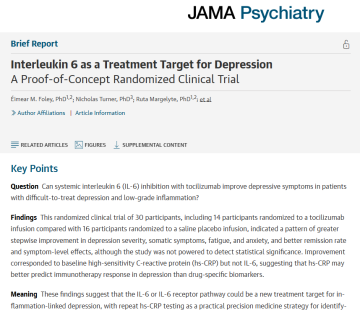
We recruited 30 people diagnosed with depression whose symptoms did not improve with standard antidepressants to a proof-of-concept randomised controlled trial called the Insight Study. All participants also showed signs of chronic low levels of inflammation (raised immune protein levels on two tests, taken approximately two weeks apart) and reported experiencing inflammation-linked symptoms like fatigue and disturbed appetite or sleep.
Eligible participants attended a baseline assessment to collect pre-treatment data on psychiatric symptoms, cognitive performance, and blood markers. Participants were then randomly assigned to receive one intravenous infusion of a strong anti-inflammatory drug, tocilizumab (N=14), or a saltwater placebo (N=16). Tocilizumab specifically blocks the IL-6 pathway and is routinely used in the NHS as a treatment for chronic immune conditions like rheumatoid arthritis, where it is administered as a monthly infusion. We then checked in with participants approximately 7, 14 and 28 days post-infusion, again measuring their psychiatric symptoms and cognitive performance, and taking blood samples.
What did we find?
While this proof-of-concept trial was small in size and short in duration, it has provided early evidence that tocilizumab may indeed reduce symptoms of depression, fatigue, and anxiety and increase people’s overall quality of life. There also appeared to be a pattern of improvement in symptoms over time. Patients reported feeling progressively better at each follow-up visit compared with the previous visit, with the greatest improvement reported at the final follow-up, four weeks post-treatment.
Higher baseline levels of C-reactive protein (a pro-inflammatory protein that is produced when the IL-6 pathway is activated) also seemed to be linked with a better response to treatment. Tocilizumab did not appear to improve participants’ cognitive performance.
Overall, tocilizumab was well tolerated, and no serious side effects were reported.
What next?
This proof‑of‑concept study provides sufficient justification to move to the next stage, a Phase III efficacy trial. Such a trial would need to be larger and more inclusive, with repeated dosing and longer follow‑up. It should also build on the practical lessons from the Insight Study (e.g., two separate blood tests to confirm chronic inflammation). This next step is essential to establish whether immunotherapy is effective as a treatment option for some people with depression.
Depression is biologically heterogeneous, and our work reinforces the idea that a “one‑size‑fits‑all” treatment model is unlikely to meet the needs of everyone. This research supports a move towards more personalised mental healthcare, where treatments are selected to better match an individual’s biology rather than relying solely on trial-and-error approaches. Inflammation will not be relevant for everyone with depression, but understanding when it matters may help bring more effective treatments to people who currently have too few options.