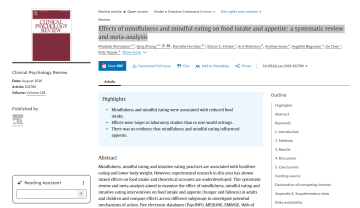
Mindful eating may reduce food intake, but evidence in real-world settings remains limited
Mindfulness and mindful eating practices could help people eat less in controlled settings, according to a new systematic review and meta-analysis published in Clinical Psychology Review. Researchers found that the effects of mindfulness and mindful eating were larger in laboratory settings and there was no clear evidence that these practices affected appetite.
The review analysed 41 articles covering 46 studies and data from 3,581 participants. It found that mindfulness and mindful eating interventions were associated with small but statistically significant reductions in food intake, compared with control conditions. However, the same interventions did not appear to significantly change hunger, fullness or satiety ratings.
Mindfulness practices typically involve paying attention to present-moment experiences, such as thoughts, emotions or bodily sensations. A person practicing mindfulness should notice these experiences with openness and without judgement. Mindful eating applies these principles to food-related experiences, including:
- Taste and texture of food
- Hunger and fullness cues
- Cravings
- Eating behaviours
Authors found the clearest evidence for reduced food intake in laboratory-based studies. This was because the controlled setting made it possible to measure the amount of food participants were eating more precisely. By contrast, studies conducted outside the laboratory showed little evidence of an effect. The research team suggests this may be because real-world food intake is:
- Harder to measure accurately
- Reductions may be short-lived
- People may compensate by eating more later in the day
Qing Zhang, joint first author, said:
“Our findings suggest that mindfulness and mindful eating can reduce how much people eat in the short term, but the effect is small and we do not yet know whether it translates into meaningful changes in everyday life.
“Future studies need to move beyond the laboratory and use more sensitive, real-world measures so we can understand when, how and for whom these approaches are most useful.”
The review also explored possible mechanisms behind mindful eating, including whether acceptance, attention regulation or sensory-focused eating might explain the effects. No specific component emerged as clearly more effective than another, and there was no evidence to support the idea that mindfulness reduced intake by changing appetite.
The authors conclude that more rigorous research is needed, including pre-registered studies, better checks that interventions work as intended, and more diverse participant groups. They also highlight a lack of eligible studies on intuitive eating, despite growing interest in this approach.