New study highlights how better communication can boost clinical trial recruitment
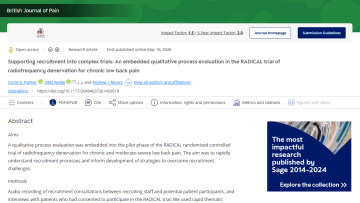
Researchers in Bristol have shown how embedding rapid qualitative research into clinical trials can help overcome recruitment challenges and strengthen study delivery, according to a new paper published in the British Journal of Pain.
The evaluation was carried out within the pilot phase of the RADICAL trial, which is testing radiofrequency denervation (RFD) for people with chronic low back pain. The team used interviews and recordings of recruitment consultations to understand how trial information was communicated and where barriers to participation arose. Their work was informed by the approach developed by the University of Bristol QuinteT team.
Their findings highlight that recruitment difficulties are often driven by communication challenges. Explaining concepts such as treatment uncertainty, randomisation and placebo interventions proved particularly complex for recruiters. Especially when discussing a commonly used procedure like RFD, whose effectiveness remains uncertain.
The study found that clinicians sometimes struggled to present treatments in a neutral way, and occasionally used language that could unintentionally suggest to patients that one option was superior. This risked undermining the principle of equipoise – a key ethical requirement in clinical trials.
Equipoise in clinical trials refers to the existence of uncertainty about which treatment is better. It means researchers and clinicians genuinely do not know whether the treatment they are testing is more effective than the alternative.
Patients’ understanding also varied. While some participants grasped trial processes well, others misunderstood key elements, including when randomisation would occur or whether they would really receive the active treatment. In one case, a participant withdrew after realising they might receive a placebo.
Importantly, the research demonstrates that even small amounts of qualitative data can generate actionable insights. By rapidly analysing early findings, the team developed practical solutions, including:
- Recruiter training sessions
- A structured consent process diagram
- Tailored guidance on communicating complex trial concepts
These interventions helped address barriers in real time and informed a protocol amendment that simplified the trial’s recruitment pathway. Following these changes, recruitment improved. Randomisation rates increased and delays between consent and treatment allocation reduced.
The authors say their findings underline the value of integrating qualitative process evaluations into clinical trials from the outset. Doing so enables researchers to identify and respond to challenges early, rather than after recruitment targets have been missed.
Dr Andrew Moore, Associate Professor in Musculoskeletal Health Services Research at Bristol Medical School, said:
“Supporting recruiters to communicate clearly and consistently, particularly around uncertainty and treatment equivalence, is crucial to improving patient understanding and participation, particularly where trials involve placebo interventions. Training and practical tools can play a key role in achieving this.”
Dr Cecily Palmer, Senior Research Associate for RADICAL said:
“All randomised trials, particularly those involving complex interventions, should consider embedding qualitative research as standard practice. A growing body of research shows that this approach could enhance recruitment, improve informed consent, and ultimately increase the reliability and success of clinical research.”