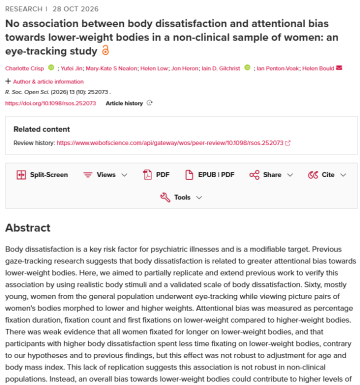
Study challenges assumptions about how body dissatisfaction affects attention to bodies of different sizes
Women who are dissatisfied with their bodies may not pay more attention to thinner bodies than other women, according to a new study led by researchers at the University of Bristol and the NIHR Biomedical Research Centre: Bristol. The findings suggest that previously reported links between body dissatisfaction and visual attention to lower-weight bodies may not be as robust as once thought.
Body dissatisfaction is a risk factor for a range of mental health conditions, including eating disorders and depression. Researchers have proposed that women who are affected by it may be more likely to focus on thinner body types. This idea has prompted interest in developing interventions that retrain attention away from appearance-related cues.
To investigate, researchers used eye-tracking technology to measure where participants looked when presented with pairs of images showing the same woman at a lower and higher body weight.
The study involved 57 women from the general population. Most were young adults and none had a current or previous eating disorder. As part of the study, they had completed a validated questionnaire measuring body dissatisfaction.
The team expected that women with higher levels of body dissatisfaction would spend more time looking at lower-weight bodies. However, the results did not support this prediction. Researchers found no clear evidence that body dissatisfaction was linked to:
- Longer looking times
- More frequent fixations
- Quicker visual attention towards lower-weight bodies
These findings remained unchanged after a series of additional analyses.
While the study found some weak evidence that all participants spent slightly longer looking at lower-weight bodies, this effect was not strong enough to draw firm conclusions. The researchers say this may indicate a broader societal bias towards thinner body types rather than a pattern specific to women experiencing body dissatisfaction.
Senior author Helen Bould, Associate Professor of Child and Adolescent Psychiatry at the University of Bristol and researcher at the NIHR Bristol Biomedical Research Centre, said:
“We set out to test the relationship between body dissatisfaction and attention to lower-weight bodies using realistic images and rigorous methods.
“Our findings did not replicate earlier studies, which highlights the importance of publishing well-designed studies whatever the results.
“While we found some suggestion that women in general may pay more attention to lower-weight bodies, we did not find evidence that this bias was stronger in women with higher levels of body dissatisfaction.”
The researchers say their findings could help refine future efforts to understand and prevent body dissatisfaction. They recommend further studies in more realistic settings and among people experiencing eating disorders, for whom attentional biases may be different.
By improving understanding of the factors that contribute to body dissatisfaction, researchers hope to support the development of more effective approaches to protecting mental health.