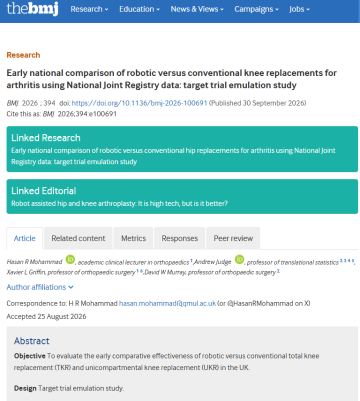
Study finds no clear advantage of robotic-assisted hip and knee replacement surgery
New research analysing data from more than 1.3 million hip and knee replacement operations across the UK has found no clear differences in implant survival, revision rates or surgical complications between robotic-assisted and conventional surgery.
The studies, published in The British Medical Journal, used data from the National Joint Registry to compare outcomes following hip and knee replacement procedures carried out between 2018 and 2024.
Robotic-assisted surgery uses computer-guided technology to help surgeons plan and perform operations. While previous studies have shown that robotic systems can improve the accuracy of implant placement, it has remained unclear whether this leads to better outcomes for patients.
To investigate this, researchers analysed data from more than 666,000 hip replacements and 697,000 knee replacement procedures performed in NHS and private hospitals across the UK. They used an advanced statistical technique called propensity score matching to ensure that patients in the robotic and conventional surgery groups were as similar as possible when comparing outcomes.
Propensity score matching is used in observational studies to estimate the effect of a treatment, policy, or intervention by pairing treated subjects with untreated subjects who share similar characteristics
After an average follow-up period of 2.5 years, the researchers found no significant differences between robotic-assisted and conventional surgery for:
- Implant survival
- The likelihood of needing further surgery to replace or repair an implant
- Complications occurring during surgery
They also found no difference in patient survival following hip replacement surgery.
For hip replacements, robotic-assisted surgery was associated with a lower risk of revisions linked to implant positioning, though overall revision rates remained similar between the two approaches.
The findings come as the NHS plans to expand the use of robotic surgery over the coming decade. Robotic systems can cost around £1 million to install, with additional costs for each procedure compared with conventional surgery.
The researchers say their findings highlight the importance of carefully evaluating new surgical technologies to understand whether they deliver meaningful benefits for patients and represent good value for healthcare systems.
Further research is underway through the RACER clinical trials, which will assess whether robotic-assisted surgery affects patient recovery, function and quality of life after joint replacement.
The researchers note that these were observational studies rather than randomised clinical trials, meaning they cannot prove cause and effect. However, the large scale of the data and the analytical methods used provide valuable evidence to inform future decisions about the adoption of robotic technology in orthopaedic surgery.
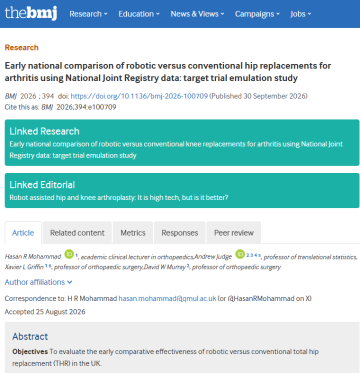
Early national comparison of robotic versus conventional hip replacements for arthritis using National Joint Registry data: target trial emulation study