Improving how surgical procedure modifications are reported
Theme Surgical and orthopaedic innovation
Workstream Innovative translational research methods
Status: This project is complete
The way new surgical procedures are developed and evaluated is very different to how new drugs are developed and evaluated. It is common for surgeon innovators to adjust (modify) a procedure as they perform it more often.
These modifications are often based on a surgeons’ reflections and experiences of performing the procedure and its outcomes. Surgeons may not always document these modifications or share them with colleagues.
This creates a lack of transparency surrounding ‘successful’ and ‘unsuccessful’ modifications. It can:
- Make evaluating a procedure difficult
- Create variation between how surgeons and centres perform a procedure
- Make it difficult to understand when a new procedure has stopped being modified and is ready to be evaluated by being compared with existing treatments
- Have the potential to perpetuate harm to patients – this could be when different surgeons make the same modification that’s detrimental to patients or when they don’t share a modification that could be beneficial to patients
Project aims
To develop and refine a framework for the identification, classification, and reporting of modifications to innovative surgical procedures.
What we did
We conducted a systematic review of 104 IDEAL (Idea, Development, Exploration, Assessment and Long-term study) studies.
The IDEAL framework is a set of recommendations designed to improve how new surgical procedures and medical devices are introduced, evaluated and monitored. It was developed because surgical innovations often evolve gradually, unlike new medicines, and therefore need a different approach to evaluation.
Our review focused on the reporting of modifications to procedures/devices in the IDEAL studies. We found that changes to new surgical procedures and devices are common, but they are not reported consistently. This means we need clearer guidance on how to identify and report modifications during surgical innovation.
We used these findings to develop a reporting checklist to help researchers and surgeons share learning more effectively and improve patient safety.
The Surgical Modification Reporting Tool (SMART) is a concise, seven-item checklist intended to complement the IDEAL framework. We developed it after completing our systematic review. The first stage of work involved developing a provisional version of the checklist. Once this was developed, we went on to refine it during 20 stakeholder interviews.
We interviewed clinicians, methodologists, industry representatives and governance professionals to explore what they thought of our provisional checklist. Our next step was to optimise the checklist’s content, wording, layout, scope and usability in line with stakeholder feedback.
Our checklist is intended to complement, rather than replace, IDEAL and IDEAL-D (IDEAL for Devices). It aims to enhance transparency, safety, and shared learning across the surgical innovation community by describing:
- The starting point of the innovation
- The context of the innovation
- Structured reporting of what changed, when and why
- Reflection on learning and innovation stability
This research project was led by James Olivier, with supervision being provided by Rhiannon Macefield, Natalie Blencowe, Daisy Elliott and Kerry Avery.
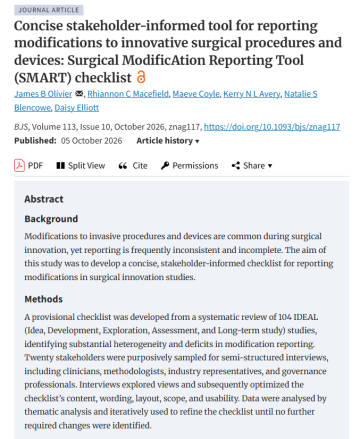
Concise stakeholder-informed tool for reporting modifications to innovative surgical procedures and devices: Surgical ModificAtion Reporting Tool (SMART) checklist