UK food insecurity interventions for families are limited and need stronger evidence
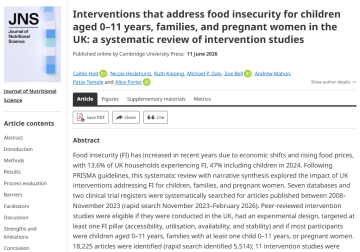
A new systematic review has found that UK interventions aimed at tackling food insecurity among children, families and pregnant women are limited in quality, scope and long-term impact. In addition, few address the full range of factors shaping whether families can reliably access healthy food.
The review, published in the Journal of Nutritional Science, examined intervention studies carried out in the UK since 2008. Researchers identified 11 eligible studies. Types of interventions looked at in the studies included:
- Free school meals
- Holiday clubs
- Cooking programmes
- Supermarket vouchers
- Food bag schemes
Most focused on improving the availability of food, but fewer addressed accessibility, food skills and long-term stability. Only one study measured food insecurity directly as an outcome, and only one partially addressed all four pillars of food security: availability, accessibility, utilisation and stability.
The authors found some encouraging signs. Holiday clubs and free school meals could improve diet quality and reduce intake of some less healthy foods, while cooking interventions were associated with improved confidence, food knowledge and family eating behaviours.
Supermarket voucher top-ups increased fruit and vegetable purchases, and food bags were linked to improved wellbeing. However, most studies were small, short-term or at risk of bias, making it difficult to draw firm conclusions about effectiveness.
The review highlights that food insecurity is not only about whether food is available. Families may also face barriers such as:
- Stigma
- Low literacy skills
- Limited cooking facilities
- Transport difficulties
- Lack of culturally appropriate food
- Insufficient money to supplement food provided through schemes
Interventions were more acceptable when they were flexible, enjoyable, community-based and delivered through trusted settings such as schools and community centres.
Dr Alice Porter, Senior Research Associate in Diet and Physical Activity at the Bristol Medical School, said:
“Our review shows that providing food can make a difference, but it is not enough on its own.
“Families need interventions to reflect the realities of their lives and address the wider pressures that make healthy eating difficult.
“This means reducing stigma, building on trusted community networks and ensuring government-level policies and funding to tackle the root causes of food insecurity.”
The authors conclude that future interventions should be co-produced with families experiencing food insecurity and evaluated using stronger study designs, including cost-effectiveness analysis.
They also call for more research focused on pregnant women and children aged under 5, who were under-represented in the evidence.