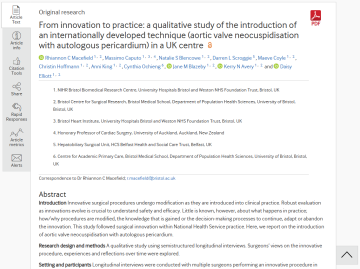
Qualitative research key to understanding how innovative procedures evolve, study finds
Researchers at the NIHR BRC: Bristol conducted a 3-year study highlighting how innovative surgical procedures can continue to change and develop after they are introduced into routine NHS care. Their finding supports the need for more transparent reporting and oversight of surgical innovation.
The research was conducted as part of the wider Lotus study. It followed aortic valve neocuspidization (AVNeo) with autologous pericardium as it was being introduced into clinical practice in a UK hospital. AVNeo, also known as the Ozaki procedure, repairs damaged heart valves by rebuilding them using patient’s own tissue. The technique aims to:
- Avoid the need for an artificial replacement valve
- Repair valve function
- Reduce the need for lifelong medications, such as blood-thinning drugs
As part of the research, the team conducted 19 interviews with 5 cardiac surgeons across time as they introduced the procedure into NHS practice. Researchers followed the innovation in real time. This meant they were able to capture how surgeons adapted and refined the technique as they gained experience and learned from one patient to the next.
Findings from the study challenge the perception that the Ozaki procedure is a relatively standardised operation. Surgeons initially viewed it as well-defined and reproducible. However, interviews revealed that over time surgeons were making incremental changes to surgical technique and patient selection.
These modifications included changes to how tissue was prepared and how replacement valve components were measured and constructed. Surgeons described adjusting the procedure:
- For anatomical reasons
- As a result of gaining experience
- To continually improve outcomes
The study also found that some changes were not always recognised as formal modifications. This lack of consistency to recognise modifications means valuable lessons learned during the early stages of innovation may not be systematically documented or shared with other surgical teams. Researchers say this can make it difficult to judge when a procedure has become stable enough for more rigorous testing, such as evaluation in a randomised controlled trial.
The authors argue that better systems are needed to support the safe and transparent development of new procedures. These include standardised reporting of modifications and more guided approaches to adapt patient selection during early-phase evaluations. The findings also highlight the important role of research and governance processes in overseeing surgical innovation as it moves from initial introduction to wider adoption.
Rhiannon Macefield, senior author of the study, said:
“Our research highlights that surgical innovation involves a complex process of continuous learning and refinement.
“By documenting and sharing modifications more systematically, we can improve learning between surgical teams. Transparent reporting as new procedures evolve will help strengthen evaluation of surgical innovation and ultimately help ensure that new procedures are introduced as safely and effectively as possible for patients.”
The researchers say their findings demonstrate the value of qualitative research for understanding how innovative procedures evolve in real-world clinical settings and could help improve the way surgical innovations are evaluated across the NHS.