Identifying biomarkers for treatment response and disease prognosis in depression
Theme Mental health
Workstream Biological interventions, trial recruitment and safety
Status: This project is ongoing
Chronic inflammation alters how the brain works, contributing to depression, cognitive decline, and other mental health conditions. Inflammation develops when part of the immune system is overactive. This overactivity can be measured by testing a patient’s blood for certain biomarkers.
Biomarkers are found in blood, other body fluids or tissues. They can be a sign of existing disease or a warning that somebody will develop a disease in the future.
It is possible that targeting inflammation could help us treat depression. This might benefit patients who currently do not benefit from existing treatments.
Immunotherapy can be used to treat a variety of conditions from inflammatory disease to cancers. It involves administering drugs that target the immune system to:
- Control inflammation
- Produce antibodies
- Train our own immune system to prevent, control or eliminate disease
We need to identify biomarkers associated with how someone with depression responds to this type of treatment. Because, we know that immunotherapy is unlikely to be useful for everyone with depression.
Finding these biomarkers would help us predict which patients would benefit from treatment and inform how future studies are designed.
Project aims
The aim of this project was to identify biomarkers that could help us predict how patients with depression would respond to immunotherapy.
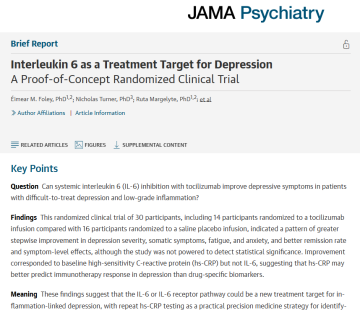
To achieve this goal, we looked at data and blood samples from the Insight study. This study aimed at assessing the effect of anti-inflammatory treatment on individuals with depression. It investigated whether reducing inflammation with an anti-inflammatory drug (tocilizumab) could help reduce symptoms of depression.
Tocilizumab is already widely used in the NHS to treat inflammatory conditions like rheumatoid arthritis. The Insight study investigated whether we could repurpose tocilizumab to treat depression.
What we did
The Insight study was a four-week, double blind, placebo-controlled randomised controlled trial of tocilizumab for depression. This means participants were randomly assigned to one of two groups.
One group was given the medication (tocilizumab) while the second group was given a placebo (saline). Neither the participants nor the researchers knew which treatment participants were receiving until the trial was over.
Patients with high inflammatory maker levels took part in the study. They were selected specifically to ensure treatment was reaching those who were most likely to respond to it.
Results from the Insight study indicated that patients receiving tocilizumab could experience improvement in:
- Depression severity
- Somatic (physical) symptoms of depression
- Fatigue
- Anxiety
- Quality of life
Tocilizumab decreased levels of C-reactive protein (CRP) indicating reduction in inflammation level in the body. CRP is a standard clinical marker of inflammation. We saw that higher baseline CRP levels, but not interleukin-6 (IL-6) levels, corresponded to larger improvements in depression symptoms.
This suggests that measuring CRP levels could help predict how a patient living with depression will respond to immunotherapy. It’s possible that measuring CRP levels could be a better predictor of immunotherapy response than measuring drug-specific biomarkers such as IL-6. IL-6 is an inflammatory protein produced by the body in response to infection or injury. IL-6 stimulates the production of CRP, and the drug tocilizumab works by suppressing the activity of IL-6.
What next?
This was a proof-of-concept trial involving only a small number of participants. However, a larger trial should now take place to verify our findings.
Researchers involved
Work on this project was led by Dr Eimear Foley, Senior Research Associate in Immunopsychiatry and Golam Khandaker, Professor of Psychiatry and Immunology and MRC Investigator at the University of Bristol.
Professor Khandaker is co-lead for the mental health theme at the NIHR Biomedical Research Centre: Bristol.